
How to Learn Piano Online: A Beginner’s Guide (2026)
As an Amazon Associate and affiliate of other partners, we earn from qualifying purchases.
This post contains affiliate links. If you buy through them, we may earn a commission at no extra cost to you.
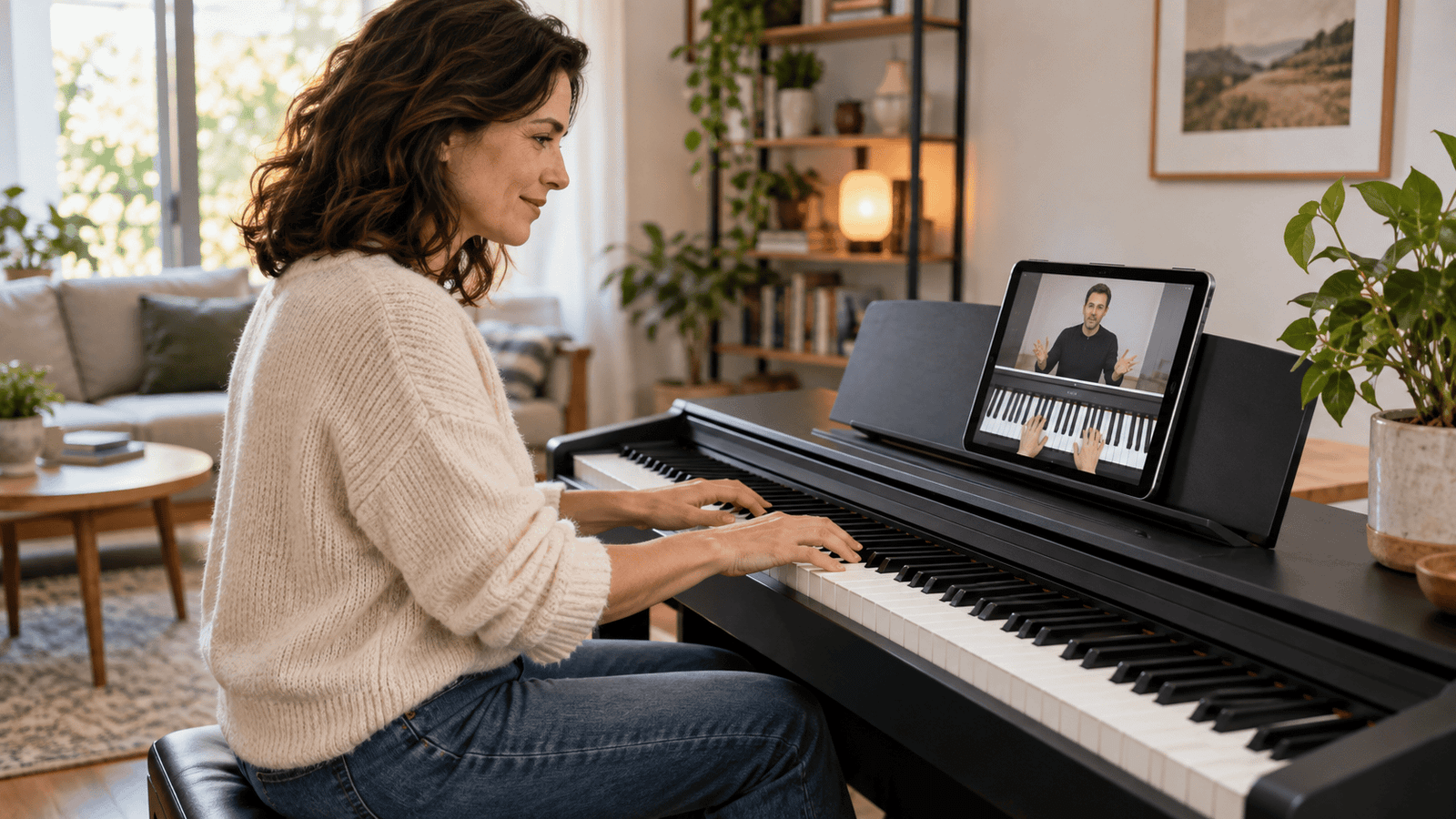
Yes, you can learn piano online, and plenty of adults do. The key is choosing a method that matches what you actually want to play.
Someone who dreams of playing pop songs at a party needs a different path than someone aiming for Royal Conservatory exams. Pick the wrong one and it’s easy to lose motivation in the first month.
This guide helps you choose a method, set up, and get through your first month.
Which Online Piano Method Is Right for You?
Start with your goal. It points you to the right kind of lessons.
| Your goal | Start with |
|---|---|
| I want to see if I’ll enjoy piano | Free beginner lessons |
| I like games and instant note feedback | A piano app |
| I want to play songs, chords and rhythms | A structured chord-based course |
| I want to read written music | A notation-focused course |
| I want to play classical repertoire seriously | A teacher or structured classical program |
| I want to take RCM exams | A teacher familiar with RCM preparation |
Each option is explained below.
Can You Really Teach Yourself Piano Online?
For most beginners, yes.
Online lessons can take you from never touching a keyboard to playing real songs with both hands. What they can’t easily do is watch you play. A teacher catches tension in your wrists or a bad fingering habit before it sets in, and an app or video can’t always do that.
That’s why many self-taught players book an occasional lesson with a teacher, even if they learn mostly online.
Get Something to Play On
You can start on a basic keyboard.
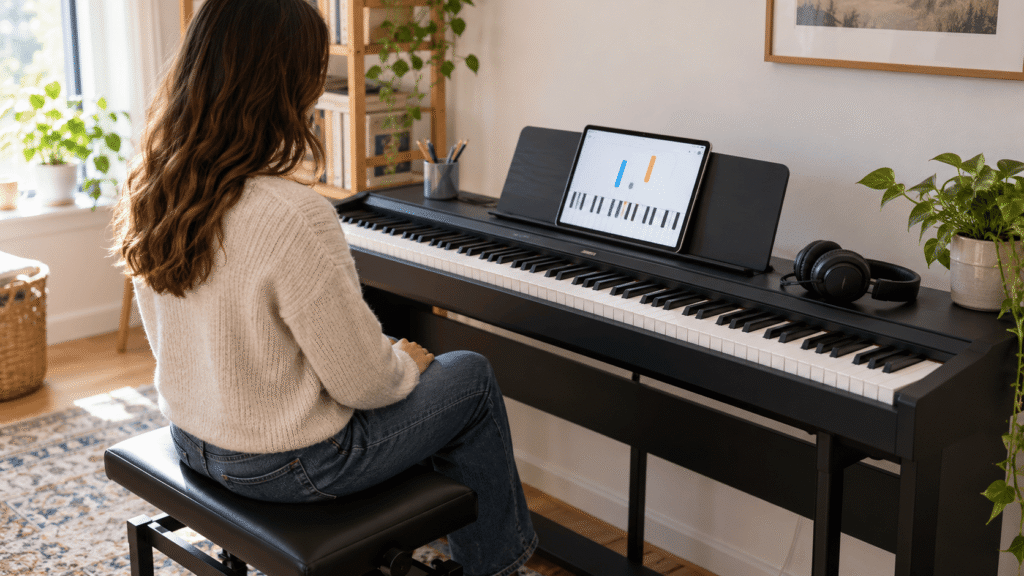
If you’re buying an instrument specifically for learning piano and your budget allows it, 88 weighted keys will give you an experience closer to an acoustic piano. A smaller or unweighted keyboard can still be enough to begin, and most apps connect to a digital keyboard directly.
Bringing home an acoustic piano instead? Think about where it goes in your home and keep an eye on humidity. If the piano moves into a different environment, changes in humidity can affect its tuning, so check our guide on how often to tune a piano to know when to call a technician.
Getting a free piano from a friend or a listing? Moving it is often the real cost. Our piano moving cost calculator gives you a range before you say yes.
The Four Ways to Learn Piano Online
| Method | Cost | Best for | Main drawback |
|---|---|---|---|
| Free YouTube lessons | Free | Testing the waters | No structure or feedback |
| Piano apps | Monthly or yearly subscription | Beginners who like instant feedback | Ongoing cost |
| Self-paced courses | Often a one-time payment | Learning at your own pace | No one checks your technique |
| Live online lessons | Paid per lesson | Exams, classical, personal feedback | Highest cost |
Free YouTube Lessons
YouTube has thousands of free beginner lessons, and some are excellent.
The problem is structure. It’s easy to jump between channels, learn bits of ten songs, and never build a foundation. YouTube works best as a supplement, or as a way to find out whether you enjoy playing before you spend money.
Piano Apps
Apps like Simply Piano, Flowkey and Skoove listen as you play and tell you right away when you hit a wrong note. That instant feedback is motivating, especially in the first few weeks.
Most run on a subscription with some free content. Simply Piano, for example, is free to download and lets you try some of its course content without subscribing. Full course and song-library access requires a paid plan.
If you start a free trial, note the end date. Trials usually turn into paid subscriptions automatically unless you cancel first.
Self-Paced Courses
A self-paced course gives you a complete curriculum that you work through in order. Many are a one-time purchase rather than a subscription, which suits learners who practise in bursts.
For learning songs with chords, Pianoforall is the course we suggest. Instead of starting with scales and sheet music, it teaches rhythm and chords from the first lesson, so you’re playing recognizable music early.
The course is created by teacher Robin Hall and delivered as ebooks with embedded video and audio lessons. It’s a one-time payment rather than a subscription, and it comes with a 60-day money-back guarantee. You don’t need to read music to begin, and sheet music is introduced later in the course.
Pianoforall is worth considering if you want to play recognizable songs and chord-based styles early and prefer a self-paced course you pay for once.
Look elsewhere if your main goal is formal sight-reading, classical repertoire or RCM exams. A notation-first program or a teacher may be a better starting point.
Live Online Lessons
Many piano teachers now teach over video call. You get a real person who can watch your hands, correct mistakes and adjust each lesson to you.
It’s the most expensive option per hour, but nothing else gives you the same feedback. It’s also the most practical route if you’re preparing for RCM exams.
Your First Month Learning Piano Online
Whatever method you choose, a simple plan keeps the first month on track.
Week 1: Learn the keyboard layout, a comfortable hand position and a few simple notes or chords.
Week 2: Start one easy song or chord progression and practise it slowly.
Week 3: Work on steady rhythm, and begin using both hands where your lessons introduce it.
Week 4: Finish one simple piece or progression instead of starting five new ones.
At the end of the month, ask yourself what you enjoyed most. Reading music? Playing chords? Learning songs by ear? Your answer tells you whether you’ve chosen the right method, or whether it’s time to try a different one.
Practice Habits That Help
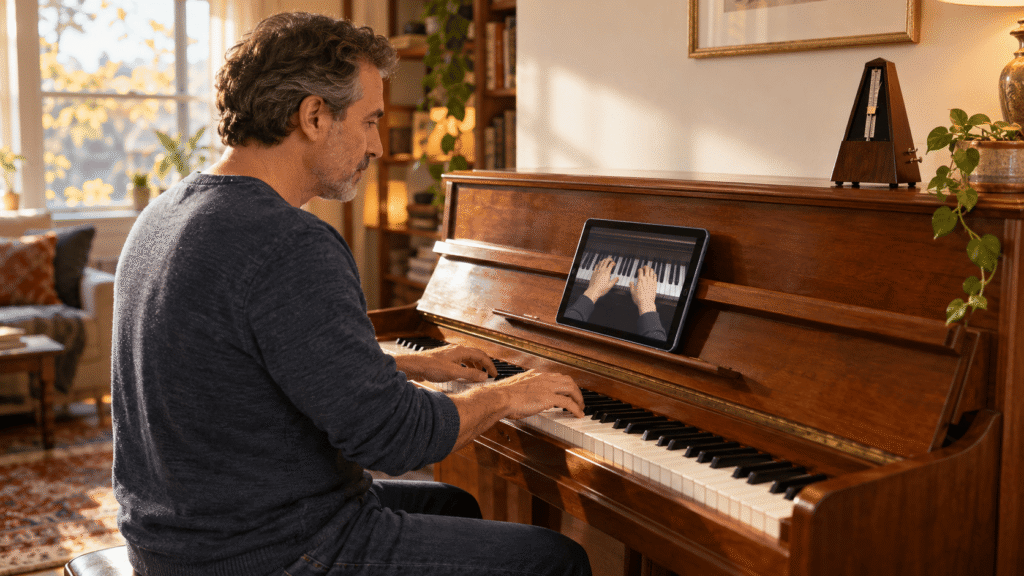
For many beginners, a short practice session most days is easier to sustain than one long session each week.
- Practise new pieces slowly. Speed comes once the notes and fingering feel natural.
- If a passage is difficult, practise each hand separately before putting them together.
- Use a metronome, even a free app, to keep steady time.
- End each session with something you already play well.
Expect plateaus. Every learner hits weeks where nothing seems to improve.
Common Mistakes When Learning Piano Online
Switching methods too often. Jumping between apps and channels feels productive, but it restarts your foundation every time. Give one method a fair few weeks before deciding.
Skipping the basics. It’s tempting to go straight to a favourite song.
Practising mistakes. Playing a wrong passage fast over and over trains your hands to play it wrong. Slow down instead.
Frequently Asked Questions
Is Simply Piano free?
Partly. Simply Piano is free to download, and its current Canadian App Store listing says users can access two free courses. Full course and song-library access requires a subscription.
Can adults learn piano online?
Absolutely. Regular practice and choosing music you actually want to play matter far more than the age you start.
How long does it take to learn piano?
It depends on your goal and how often you practise. With regular practice, many beginners can play simple songs with both hands within a few months. Reaching an advanced level takes years.
What is the 80/20 rule in piano?
The 80/20 rule is the Pareto principle applied to practice. In piano, it’s often used to mean spending most of your practice time on the small sections that need the most work, instead of repeatedly playing an entire piece from beginning to end. It’s a practice strategy, not a formal rule of piano playing.
Do I need a real piano to learn online?
No. A digital piano or keyboard is enough to start.
Start Small, Start This Week
The best method is the one you’ll actually stick with.
Pick your goal, choose a method that matches it, and play a little most days. A month from now, you’ll know far more about the kind of pianist you want to be.