What Is the Best Humidity for a Piano?
What is the best humidity for a piano? Manufacturer recommendations vary, but around 40% to 50% relative humidity is a practical target for many acoustic pianos. Yamaha Canada calls 40% to 45% ideal, Steinway recommends 45% to 50%, while some manufacturers allow a broader range. What matters most is avoiding large or rapid swings.
Here’s what actually affects your piano and how to keep it in a healthy range.
The Best Humidity for a Piano by Manufacturer
Different piano makers give slightly different numbers, which can be confusing. Here’s what the major manufacturers actually say.
| Manufacturer | Recommended Range |
|---|---|
| Yamaha | 40% to 45% |
| Steinway | 45% to 50% |
| Bösendorfer | 40% to 60% |
| Fazioli | Keep between 30% and 70% |
| C. Bechstein | 40% to 60% |
These ranges aren’t directly equivalent. Some manufacturers publish an ideal target, while others give a broader acceptable operating range. Regardless of which range you use as a benchmark for the best humidity for a piano, consistency matters more than hitting an exact percentage.
Why Stability Matters More Than the Exact Number
A piano is built largely from wood, and wood responds to moisture in the air. When humidity rises, the piano absorbs moisture and swells slightly. When humidity drops, it releases moisture and contracts.
Repeated expansion and contraction can contribute to tuning instability and other problems over time. A stable environment is generally preferable to one that repeatedly swings between very dry and very humid conditions.
Humidity swings can lead to:
- Tuning instability, since string tension shifts as the soundboard moves
- Sticking keys, as felt and wooden action parts absorb moisture
- Drying and cracking of wooden components in very dry conditions
- Corrosion or rust on metal components in persistently damp conditions
Canadian Climate Considerations
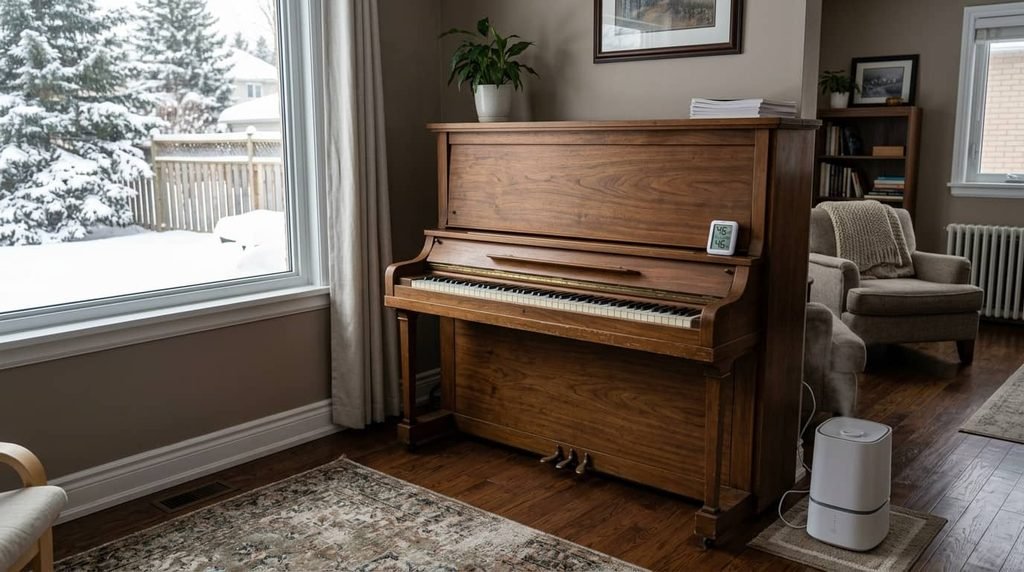
Canadian homes can experience large seasonal changes in indoor humidity, particularly where winter heating dries the air and summer conditions bring higher moisture levels.
These seasonal changes can contribute significantly to tuning instability, which is why many piano owners choose to monitor and manage humidity rather than leave it to chance.
How to Monitor and Control Humidity
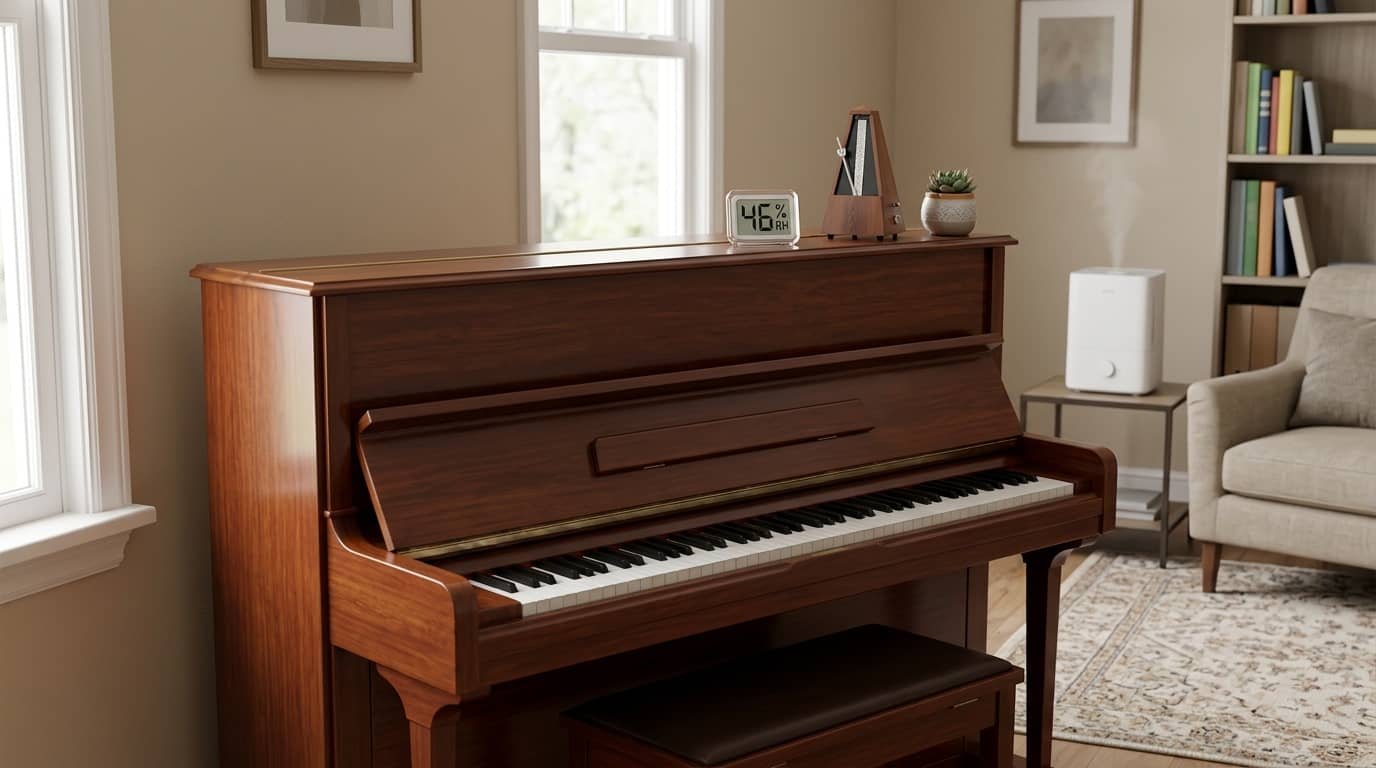
A hygrometer is the starting point. This small device measures the relative humidity in the room, giving you actual readings instead of relying on how dry or humid the air feels. Look for a hygrometer with a clearly stated accuracy specification and an easy-to-read display. The Piano Technicians Guild notes that humidity fluctuations are one of the most common causes of tuning and touch problems in acoustic pianos.
Room humidifiers can help during dry winter months, particularly in homes with forced-air heating.
Dedicated piano humidity control systems, such as the Piano Life Saver system, are installed in the piano and help regulate humidity around the instrument’s sensitive internal components. These systems are typically installed and serviced by a piano technician.
Where you place the piano matters too. Avoid placing the piano where it will be exposed to direct sunlight, heating or cooling airflow, or other localized temperature and humidity changes.
Frequently Asked Questions
What happens if piano humidity is too low?
Very dry conditions can cause wooden components to shrink and may contribute to cracking and tuning instability.
What happens if piano humidity is too high?
High humidity causes wood to swell, which can affect the action and touch of the keys. It can also lead to corrosion on metal components, and in extreme cases, mold growth.
Do I need a humidity control system, or is a room humidifier enough?
In some homes, monitoring with a hygrometer and using room-level humidity control may be enough. Homes with larger seasonal swings may benefit from discussing a dedicated piano system with a technician.
How does humidity affect piano moving?
Moving a piano between environments with different humidity levels can affect its tuning. Learn more in our guide to how often you should tune a piano, or see how much it costs to move a piano in Canada.